
Lighting For Hot Pepper Plants
updated 11/19/24
Once your sprouts have germinated you will need to start giving them light right away. You can also remove the heat mat. You don’t want to cook your plants! Some people put their plants near a sunny windowsill, but chances are they will get long and spindly (leggy). Installing specialized grow lights will ensure your plants grow big and strong. The more plants you have, the more lights you’ll need.
I recommend LED lights due to their efficiency and relatively low heat output. If you are looking to get more heat out of your lights (if you’re growing in a cold climate) I would recommend a T5 fluorescent light fixture.
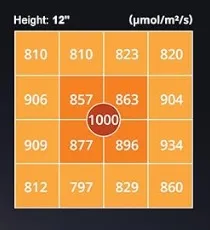
When researching grow lights be sure to look at the PPFD (umol) chart to see the coverage. Most lights typically drop off in strength towards the edges. This image is from the VIPARSPECTRA 2024 XS1500 Pro – notice how the numbers remain similar throughout?
For further research, cocoforcannabis.com has some great info on grow lights.
Recommended Lights
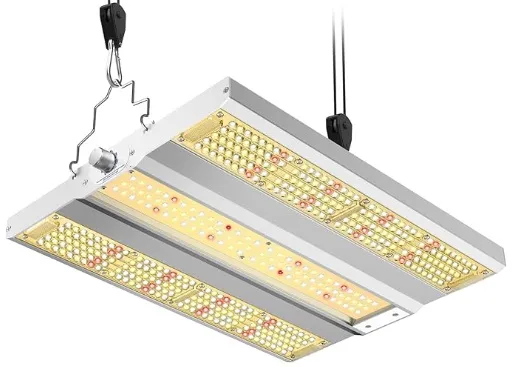
The VIPARSPECTRA 2024 XS1500 Pro lights are currently my favorite. (They also work well with medicinal plants) 😉 They often have coupons on Amazon and can be had for around ~$90 or so.
I’ve been using them for a little over a year. For peppers, they would cover around 3′ x 3′ of space. They have a dimming knob on the side that allows you to choose between 4 different light intensities.
While many LED lights taper off and get weaker towards the edges, this one provides great uniform coverage throughout. Two of these lights would provide coverage for a 3′ x 6′ grow space for peppers.
*Cheaper options: Mars Hydro TS100, Spider Farmer SF1000, and similarly priced lights from AC Infinity, and Vivosun.
Fluorescent vs. LED Lights
We all know by now that LED lights are more efficient and cheaper to run than fluorescent lights. However, fluorescent lights put out a lot more heat, which can be desirable if you grow in a cold environment.
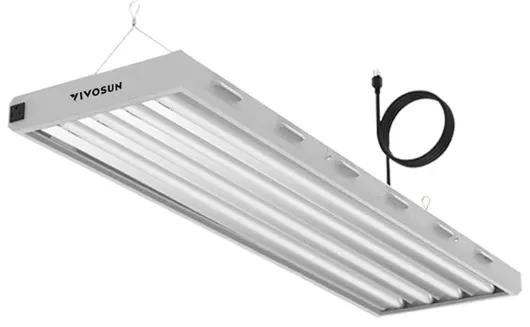
Fluorescent light fixtures come in many different sizes. I’ve always been partial to the 4′ x 4-bulb fixture pictured here. I recommend using T5 fluorescent light bulbs. The color temperature should be around 6500K which is suitable for growth. Bulbs with a Kelvin rating of around 3000K would be more suitable for flowering plants. If you plan on running fluorescent lights throughout your entire grow you will need to switch the bulbs from 6500K to 300K when your plants begin flowering/fruiting.
Climate
Hot pepper plants thrive in temps around 70-80 degrees. Temps lower than 60 degrees will cause their growth to stall. I purchased a grow tent to help contain the heat a bit more. With two of my 4′ Hydroplanet lights in my grow tent, I can raise the temps from 55 to about 80 degrees!
How Long Should My Grow Light Be On?
I have mine on for 15-18 hours per day. I reverse the cycle so that the lights are off during the warmest part of the day. This helps with extreme temperature drops. I run my lights from 8:30PM to 2:30PM.
How Far Should the Grow Light Be From the Plants?
Depending on the light you use, you can put it anywhere from 2″-12″ or higher above the plant. Read the manual that came with the lights. It’s better to start farther way (20″-25″) and if the seedlings get too leggy move the light closer an inch at a time. If the lights are too close you could burn them to a crisp!
Rotating Plants with LED lights
LED fixtures can emit light at different intensity (typical with lower quality lights). In the picture below you can see how the light intensity (PPFD) drops the further you get from the center of the light. Plants furthest from the center are going to receive less light than plants directly under the light. To ensure all of your plants receive the same amount of light, the simplest thing to do is rotate your plants/trays every few days (or when you water them). Typically, higher quality lights will have a more uniform spread.
